I might not have read many books in June, but I may have read my favourite book of the year…
The Kingdoms by Natasha Pulley is a flipping masterpiece. Her novels always a dive into gentle, surreal worlds populated with deeply flawed but undeniably loveable characters on wild adventures, and The Kingdoms didn’t disappoint. Pulley plays masterfully with a time bending plot, all woven together by two of the most brilliantly compelling main characters that I’ve read in such a long time. I tore through this a few weeks ago and I’m still thinking about it now. It’s thrilling, wonderfully written, and immersive. I don’t care what kind of novels you usually enjoy – read The Kingdoms and you’ll have a whole new author to rave about.
Eye of the Sh*t storm by Jackson Ford is also rather good. Apologies to Ford – it’s hard to follow a review like the one above, but I feel like if any book can do it, it’s this one. It’s witty, action packed, and so well crafted. The food descriptions are some of the best I’ve come across and the world that’s being woven in the third of this series is consistently both gritty and inherently human (even when some of the characters aren’t quite human…) This is a great novel for fans of inverted superhero tropes and fried chicken.
Read them all, and we can be chums 😊
One tiny disclaimer – if you struggle with reading about suicide, then I would avoid Dog Days by Ericka Waller. This is a great book, full of DOGS and damaged humans, but there is also a scene later in the book that I found incredibly difficult to read. Look after yourselves!
How to make sure conversations in your stories flow
I’ve started sharing some of the feedback I find myself giving to lots of my editing clients. This time it’s all about MEANDERING DIALOGUE.
A disclaimer for my editing clients – I will NEVER use specific examples or talk about your stories! These threads are based on feedback I have given to MANY clients, so I am not secretly talking about your work.
Now, there are three main reasons dialogue can feel like it’s meandering all over the shop:
It goes on for too long
The point of the conversation isn’t clear
Switches in subject feel random
I’m going to use a short section from Goldilocks by Laura Lam to explore all of these areas. If you haven’t read this book yet, why the heck not? But don’t worry – there will be no spoilers!
This is a discussion between the main character, Naomi, and her mentor, Valerie:
This is a great section. Short, sharp, to the point. This is a whole, separate piece of dialogue that moves the story along, tells us about the dynamic between the characters, and, most importantly, will help us unpick some meandering dialogue issues…
1. DIALOGUE THAT GOES ON FOR TOO LONG
This is usually because there is too much said before or after the real crux of the conversation. Too much information is being included, and this can make the conversation feel overly long.
Consider the section from Goldilocks again. This conversation is taking place on a journey after the two women haven’t seen each other for a while. Valerie has travelled for a long time to visit Naomi. Do they talk about putting their seatbelts on? Does Naomi ask if Valerie wants a shower to wash away the travelling? These could both have been used to pad out the start of the conversation but they aren’t, because they aren’t things the reader needs to know. Do you think these two women spent the rest of the car ride in silence? Probably not. But their chats for the remainder of the drive are not important enough to be included. The reader can assume they’ve happened, without actually witnessing them all.
Those things wouldn’t make for bad dialogue, they could be well written and carefully integrated, but they aren’t needed. And that’s a hard thing to face when looking at our own stories – is every line of dialogue absolutely essential?
The first two places to look if you feel like your dialogue is meandering is at the start and end of conversations. This is when the advice ‘start late, finish early’ is worth its weight in gold. One way to really interrogate whether every part of your dialogue is needed is to print off each section and grab a highlighter. Be ruthless, and only highlight those sections that are really, totally essential. Then get even meaner – explain to yourself why each part is needed. Is it furthering the plot? Developing character? Filling in backstory? Hinting at something to come? You can leave in some sections where the reason for keeping it is I LIKE IT but if you’re finding your speech is full of these bits, then it might be time to cut them out.
Now, only you know your story and where it sits in the genre/age group you’re writing within. It might be that including more filler moments gives your book a cosy, conversational feel – and that’s fine if it fits the type of book you’re writing. But be honest with yourself and shave off those starts and ends where you can.
2. THE POINT OF THE CONVERSATION ISN’T CLEAR
Let’s go back to Naomi and Valerie. What is the point of this conversation? This is slightly easier because it’s a short section, but this should be evident in all dialogue. The point here is that Valerie has some reason for her visit that Naomi wants to know, and it also shows off some of their relationship dynamic.
Imagine if they’d had this conversation instead:
‘How was your flight?’ Naomi asked.
‘It was good,’ Valerie said.
‘Let’s get you settled then.’
Firstly, it’s bland and boring. But secondly, what is the point of this exchange? It might be to show some of the care Naomi feels for Valerie, but what else is there to it? This care can be showcased in so many (more creative) ways than with this section of dialogue.
Again, it’s time to be brutal. Is there dialogue in your novel that’s nice and maybe serves a purpose but has no real, driving point to it? Find each section of dialogue, even weeny ones like this, and question them – WHY ARE YOU HERE? If the answer is evident, that’s great. If not, maybe it can be cut. Even if the meaning is clear – ask yourself, is this showcased somewhere else and I don’t need the dialogue to say it as well?
As I said, the point can be harder to find in longer conversations, and you may need to split these into sections that serve different purposes. If there are parts that don’t serve a purpose, maybe they can be reworked or cut out.
3. SWITCHES IN SUBJECT FEEL RANDOM
Imagine if Naomi said directly after this:
‘I’ve really gotten into sudoku recently.’
This would be… strange. Why is she telling Valerie about this new hobby? And why now?
Now, I’m not saying that random switches in the conversation can’t happen. However, they need to be clearly explained to the reader, especially if it’s the main character making this abrupt change.
If it was changed to:
Naomi hated awkward silences. ‘I’ve really gotten into sudoku recently.’
Then the reader understands why she’s said this random thing.
During these conversational shifts, it’s really important to let the reader know what your main character is thinking and feeling. This smooths the way for these changes in direction, and makes sure that your dialogue flows from one topic to another.
So, pick a longer section of your dialogue. In the margin, pop a star each time your conversation changes direction – a new subject is aired, a question is asked, an action is suggested. And then make sure that this has been clearly explained or set up by your main character’s inner world. If they suggest getting dinner, have you shown them feeling hungry? If they accuse someone of murder, have they put the clues together in their mind?
In the Goldilocks example, there is no inner monologue from Naomi BUT what she’s thinking/feeling is clear. Valerie states it, and then Naomi’s speech backs this up. Use those other characters, especially when working in third person.
Just one last thing to say – dialogue that is sharp, clear, and smooth is actually incredibly unrealistic. Real conversations are full of interruptions, totally random shifts in topic, people not listening and getting distracted… We are terrible at talking to one another, really!
BUT that wouldn’t make for very compelling reading. So, forget about realism and think carefully about what you want to get across with dialogue. Say it,then then stop talking.
I’m going to start sharing some of the feedback I regularly give to clients, along with tips to help you find and change/strengthen these things in your own stories. Let’s start by chatting about AGENCY. (To find more of these on Twitter, search #EditingTipsFromAnna)
Teeny disclaimer for my editing clients: I will never use specific examples or show any part of your stories! This might have formed part of the feedback you received, but I will never, ever talk about YOU or your words.
Anyway – what the heck is character agency?
Boiled down, agency is your main character doing stuff and moving the plot forward. It’s closely linked to their aims/wants/needs/fears. Basically, it’s your MC acting on inner impulses and making the story happen. Rather than things happening to them, they are going out and getting shit done.
Side note – agency is actually pretty unrealistic. We all take action and push towards our goals, but life throws a lot of randomness at us that we have no control over and can’t form a neat narrative around. I think this is why a lot of writers struggle with giving their characters agency. It’s more realistic for lots of things to be thrown at them. However, that doesn’t make for a very compelling story.
As a reader, it’s easy to spot when a character is lacking agency. Either their aim/wants/needs/fears won’t be clear so their actions feel random, or lots of stuff happens to the character rather than them doing things. As a writer, lack of agency can be tougher to pin down. Loads of stuff might happen in your novel, and how can you figure out whether or not this action is being prompted by your MC? This can be especially difficult since you do need a certain amount of external story propellers. Your MC probably has no control over their wider world, the actions of their friends and family, the weather… but they can act within these.
So how can you spot character agency in your stories? First, write out what happens in your novel, point by point. This is a bit different to a synopsis, as you don’t have to keep it short or prune anything out.
I’m going to use The Hunger Games by Suzanne Collins as an example to show good agency. If you’ve not read this already – why the heck not? And prepare yourself for a few spoilers.
You’ve written a point by point run-through of your plot. Now, grab a highlighter, and mark every element that is prompted by action from your MC. This is what this would look like for the opening section of the Hunger Games:
There is a good mix of Katniss taking action and other stuff happening. But this is how that opening section would look if her agency was taken away:
Stuff is still happening in this agency-less version, but it’s so much less engaging and exciting! Now, I don’t know how highlighter-full your plot is looking. If it’s a bit bare, don’t despair! Realising your MC lacks agency can feel demoralising but it’s an easy thing to fix.
The first thing to establish is your MC’s aim. This is crystal clear for Katniss – she wants to protect her family/survive the games and return to them. Every action she takes is informed by this. So, take a look at your plot with your MC’s aim in mind. Is every action they take pushing towards this, even if this sometimes conflicts with that they want or forces them to face their fears? What Katniss really wants is a peaceful life. She doesn’t want to fight or lead a revolution, but she is forced into a situation where she has to act contrary to what she wants to achieve her main aim of protecting her family.
Making this aim clear will ensure that your character’s actions are understandable and it gives readers something to root for. Katniss makes things happen, but her actions would feel random without her aim to protect her family. What is your main character’s aim? They might have been thrust into a situation, but what are they going to take control of and push towards? Answer these questions, and then go back and thread agency into your story.
Hopefully, this will just require adjustments. You probably already had an aim in mind, but might not have attached it to your main character or used them as the driving force behind it. However, sometimes adding agency needs larger scale changes. If Katniss had been picked in the Hunger Games originally, writing in Prim getting picked and all that this entails would have required a major rehaul.
BUT putting good character agency into your stories will make them so much stronger. You’ve already written a novel, so you’re more than capable of rehauling it and making it shine!
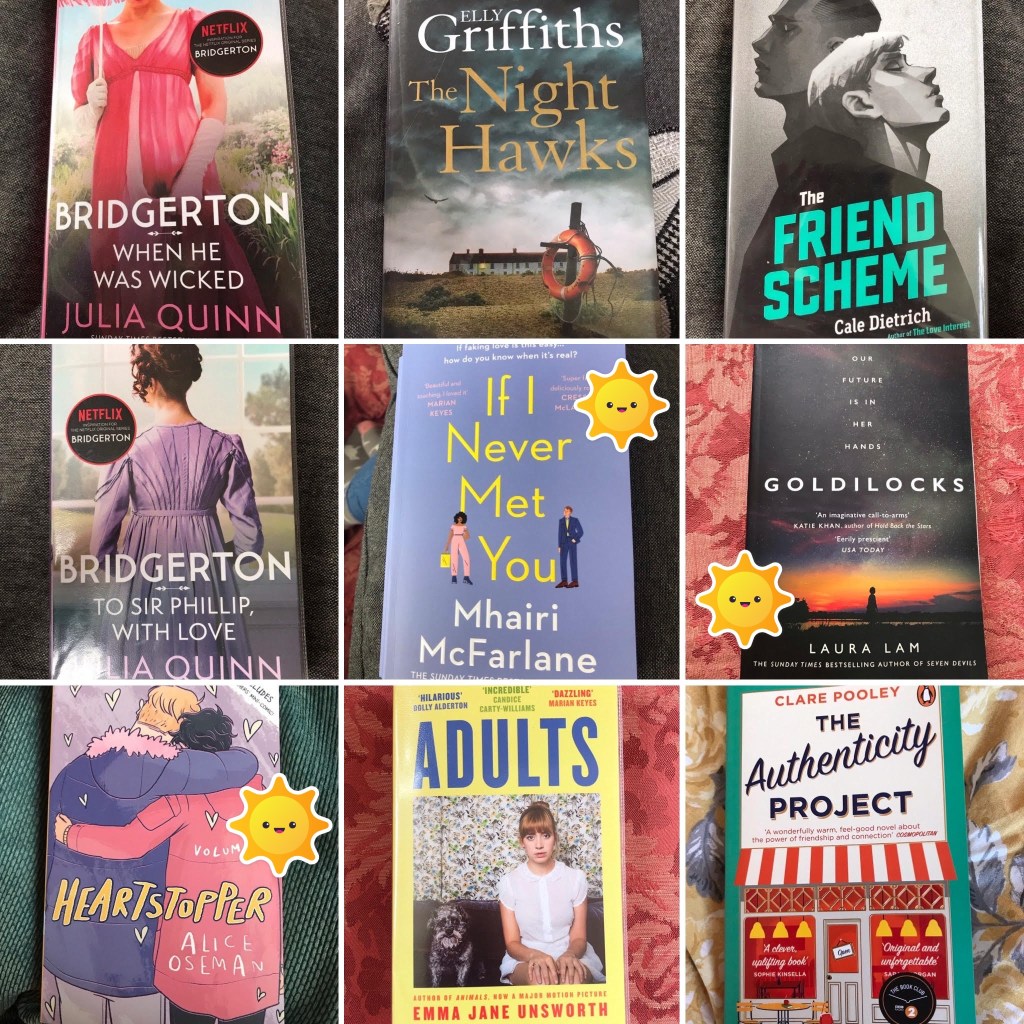
I had another great reading month in May. Here are my faves…
Goldilocks by Laura Lam BLEW MY MIND. Set largely in a space ship headed for a new planet that could be a place for humans to live after they’ve messed up earth, this story has both global and personal reach. Told from one woman’s point of view, we travel with her through space and learn of a brutal betrayal, a new hope, and are with her as she has to make impossible decisions. This was genuinely a book I couldn’t put down, and it’s perfect for fans of Becky Chambers, Margaret Atwood, or anything spacey.
If I Never Met You by Mhairi McFarlane is another smasher. If you love romance tropes like friends to lovers to enemies to who knows, people stuck in lifts, and the make-over moment, then you’ll love this. It takes these elements and makes them feel fresh and clever. I love Mhairi’s books because they feature 30-something women with actual working brain cells – this one in particular features a solicitor who struggles with her love life and it’s such a refreshing thing to see. This is a must read for fans of Stephanie Butland, Jenny Colgan (I’ll warn you now – there’s less baking BUT you’ll survive), or Marian Keyes.
Heartstopper Volume 4 by Alice Oseman is, you guessed it, the fourth in a series that follows one of the most heart-warming and authentic love stories currently being written and illustrated for young adults. Get ahead of the trend as this is being adapted by Netflix, and then it will be EVERYWHERE. Yay. Ideal for fans of Simon James Green and Patrick Ness.
As always – read them all and we can be friends, okay?
Receiving feedback on beloved stories can be one of the most wonderful things in the world. It can also be incredibly tough, since that fresh pair of eyes will spot things we didn’t in the ONE MILLION times we scoured our words.
Below are some of my tips for taking the sting out of even the most brutal critique.
BE CAREFUL WHO YOU CHOOSE
Do you want cheerleading, some grammar and sentence structure help, in-depth character analysis, or feedback on your structure and pacing? Decide what you want BEFORE you ask someone to read your story, and make sure that person knows what you want and is willing and able to provide it.
My mum reads all my novels and she is one of the loveliest first readers in the world – providing encouragement to keep going. My beta readers will chat big picture stuff with me and lament over how much they want to smush my characters and make everything better. My critique partners provide me with detailed, often line-by-line, feedback on exactly what is and isn’t working. All these readers provide different comments and critique, and I’m careful to figure out where someone fits in this spectrum before I ask them to read anything of my stories.
It’s incredibly frustrating to seek one type of feedback and constantly receive another. And it wastes both your time and theirs. If there is someone reading your work and the comments always leave a sour note, then ask yourself if they are providing something you don’t want or need right now.
BUT don’t just blame yourself. A few years ago, I started swapping with someone and too late I realised that their comments always veered to the critical end of the spectrum. Now, that could have been because what I was sharing with them was utter shit, but they should have found at least one or two things to complement each time, even if it was just the font I chose. Their comments always made me feel low. Once I realised this, I extracted myself from the situation. (If you’ve swapped with me before and are now wondering if I’m talking about you – I’m not!)
Be careful before you share your work with someone. Begin by just sharing a little, and make sure that expectations are clear on both sides. If you’re not happy with the feedback, then you’re under no obligation to share any more of your work with that person. Go out and find someone who understands your story and will give you the level of feedback you need.
TAKE YOUR TIME
In the toxic swapping situation I mentioned, I would read the feedback and even days (weeks, MONTHS) later, it would raise my hackles. I would rarely change anything in my story based on their comments, and I always felt like they were pulling me in directions I didn’t want to go.
However, there is some feedback that initially will make us rage and cry and call down a hoard of vengeful flying monkeys, but after a few days it will sink in and begin to make sense. Perhaps it cut too close to a darling you couldn’t bear to part with, or maybe it suggested changes you couldn’t face making, but slowly those comments return to your mind more and more and, instead of feeling the rage, you feel excited about how the changes can enliven and brighten your story.
Strangely, this doesn’t always mean you’ll 100% agree with the feedback. You might decide to go in another direction totally, but something in those comments unlocked a creative bubble in your head and let you fly.
That’s why I always suggest that my editing clients take at least a day or two after receiving feedback to make any changes to their manuscript. There might be some comments they adamantly disagree with when they first read them, but then those tough words help them push through a creative block.
This can also go the other way. Sometimes, having someone interact with our work can be exciting in itself. I’ve run off after getting feedback and started making changes, only to totally run out of steam a few days later when I realised I didn’t quite want to go in that direction, and now I need to change it all back again.
Take time to sit with feedback, even the stuff that feels 100% wrong or right. You might go in the exact same direction you decided to seconds after reading it, but giving yourself a day or two to digest will give your subconscious time to play with the new ideas and produce something even bigger and better.
REMEMBER THAT IT’S YOUR STORY
That means that only you can decide what to add, change, or cut. Feedback may batter you, but even dissenting voices will help you refine and grow confidence in your vision. Cherry-pick the feedback that strengthens and develops your story, and feel free to ignore the rest.
There is one exception to this rule, and that’s when you repeatedly get the same feedback from reader after reader. I had a scene in one of my young adult novels that I thought was really clever. I believed it displayed the differences between two characters and inventively detailed the changed world they found themselves in.
I was wrong.
Reader after reader commented on this section. They either misinterpreted it and didn’t like what it said about a previously gentle character, or they didn’t understand it. I thought this was a great scene, but it just didn’t work. Ultimately, despite the pain, I cut it.
You might be able to save those scenes that people keep tripping up on. There might be something to strengthen or tone down, description could be cut or dialogue smoothed, but if there is something that keeps cropping up again and again, then it needs to be addressed in some way.
As always though, there is an exception to every rule! And maybe that scene is meant to trip readers up. Maybe it’s there for a good reason and they will figure that out later. Only you, the writer, knows this.
Use your power to ignore everyone you please wisely.
And wield this power of wilful ignorance with grace and kindness. Even someone who gives you terrible story advice again and again is investing in you as a writer. You might choose to step away from them, but you don’t have to be cruel. It takes a great deal of time and effort to give feedback on someone else’s words, so make sure to honour the commitment they made to you and your story, even if you’re going to totally ignore them and carry on your merry way.
I hope these tips are helpful. Feedback can be inspiring, and I hope you find great people to share your work with 😊
April was a great reading month – one of those where I’d recommend all of these! It was hard to pick my favourites – but these three were LUSH…
Leave the World Behind by Rumaan Alam is one of the most beautiful things I’ve read in a long time. At one point there is a page-long description of what one of the main characters buys from the supermarket, and I was RIVETTED. This story is chilling and compelling and incredibly human – perfect for fans of Elizabeth Strout or Becky Chambers.
Love After Love by Ingrid Persaud is not a book I would expect to love. Chapters are often set weeks or months apart, giving each the feel of a short story. Not usually my bag, but this story grabbed me and wouldn’t let go. Set on the island of Trinidad and told from three very different perspectives, this exploration of family, betrayal, and community is great for fans of Kazuo Ishiguro or Bridget Collins. But a head’s up – there are some GRAPHIC sex scenes, so if you’re not up for that you might want to give it a miss.
I picked up Last Night by Mhairi McFarlane simply because the cover appealed to me. It did not disappoint. Set after the death of a best friend, this weirdly uplifting novel explores the destructive power of secrets, how love can rise up from something very shit, and the importance of holding your friends close. A must read for fans of Jenny Colgan or Beth O’Leary, this is a book you’ll read with a smile on your face.
But, as always, read them all and we can be chums 😊
We all have those times when writing is an absolute dream. The ideas flow, the words actually make sense, we smash targets and get great feedback. These moments are lovely. But they can also be fleeting.
These inspired periods cannot be depended on if we want to write regularly. I don’t know about you, but most days I don’t launch straight into my story in a storm of wonderful ideas. I have to ease my way in, figure out my next moves, and, if I’m lucky, I’ll fall into a good head space about halfway through. Other days, I create a space for writing and I get the words down even though I’m not particularly inspired.
But then there are the other times. The times when every sentence feels like a mess, when every idea feels contrived and unoriginal, when people don’t get your vision and, no matter how much time and effort we put in, we just aren’t writing enough. Hopefully, this lowness doesn’t hit you too much, but when it hits me it’s almost debilitating. I keep writing because I’m too stubborn to stop, but there’s a lot of angst around it.
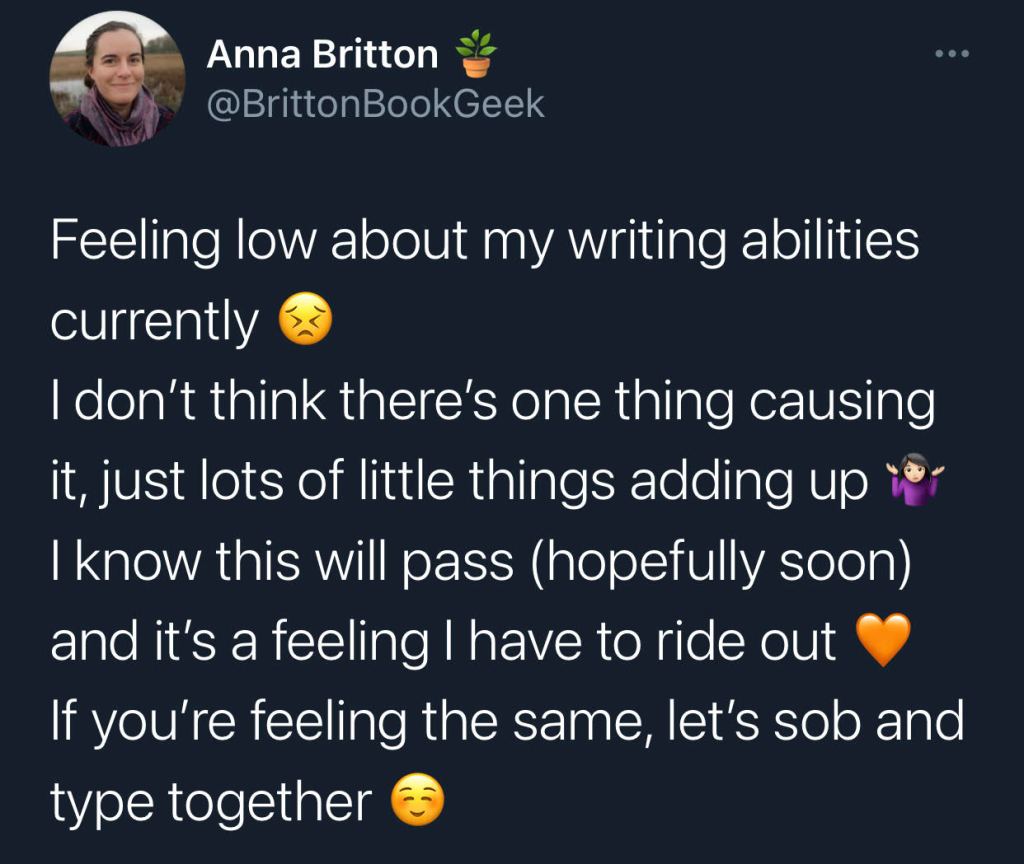
I recently tweeted about feeling low about my writing abilities:
I got some lovely responses (thank you if you said nice things, it genuinely helped) and I have been thinking a lot about lowness and how it can affect our writing. Below are some of my reflections. These are very much things I am also saying to myself – I always need a reminder.
FEELING LOW IS NOT A REFLECTION OF THE QUALITY OF YOUR WRITING
It’s all too easy to equate feeling bad about our writing ability with our writing being bad. This isn’t the case though. I don’t know about you, but when I read through my work I have no idea which sections were written when I was feeling confident about my writing or when I was feeling low. Despite the voice inside telling me that I’m not a very good writer, the work I produce is of a similar quality.
This lowness is just a feeling, not a fact. This feeling has no bearing on whether I am a good or bad writer. I might feel low about my abilities, but that doesn’t change them.
WHAT GOES UP MUST COME DOWN
There is one time when lowness hits particularly hard and predictably. You finish a first draft, you race through a round of edits, you get some lush feedback – and you feel great. For a while. This is the high and, if you’re the same as me, this will often be followed by a low.
Recently, I finished editing something that I’d been working on for about three months. I felt like a king. I would say I actually felt proud of what I’d produced, which is quite a rare thing for me. I sent the new draft off to my agent and dove into writing a first draft of something I’d been wanting to write for a while, and for a week or so everything was hunky.
Then the lowness hit. The story I’d felt so confident about only days ago was suddenly probably a pile of crap and my agent would hate it. The draft I’d launched into was too slow, too boring, too meh. I wasn’t a good writer and I should stop trying. That’s what the lowness was telling me, anyway.
I really want to get better at anticipating this kind of low time. It’s natural to come down from a high – to have some doubts and be a bit unsure. I want to create more of a space for this feeling and be gentle with myself instead of ploughing on regardless. I’m not there yet but, with practice, I’m hoping I’ll find ways to stop this low knocking me back so much.
YOU DON’T HAVE TO STOP, BUT YOU COULD TAKE A BREAK
I’m a stubborn fool. It comes from having a ridiculous drive (I WANT TO BE AN AUTHOR AND I WANT IT NOW SO I’M GOING TO WORK WORK WORK WORK UNTIL I GET WHAT I WANT). This can be great, but it can also be quite punishing. What I need when I’m feeling low is a much more compassionate mind-set, not an internal voice screaming I must do more because that’s how I will get what I want.
I want to be an author but I don’t want to be miserable, so sometimes that means I won’t do quite as much writing as the drill sergeant in my head demands. I might not write as quickly as I’d like, but I’d rather be gentle and feel better about myself than finish projects slightly sooner.
This is something I’d still learning to be comfortable with, but breaks are really good. I have a day a week when I don’t write at all. At first I struggled with this, but gradually I’ve come to enjoy it. I read loads on that day and do other fun things that get me out of my head. I often find that the couple of days after this enforced break I am brimming with ideas and energy. Taking a break reminds me that my whole life and worth doesn’t revolve around writing. This is great when I’m feeling low, because I know writing is not the only thing I have going for me.
REACH OUT WHERE YOU CAN
You might not feel comfortable shouting about your low times on social media (most of the time I’m the same but I do try to be honest about the triumphs and struggles of writing) but find some people you can reach out to when you’re feeling this way. People who will buoy you back up and say nice things until you start to believe them a little bit.
It’s ideal if these people are writers, because they’ll get what you’re talking about. They will have felt exactly the same way at some point. I personally find this incredibly reassuring. I’m an anxious bean, and get slightly concerned when I’m feeling low that I’ll feel this way FOREVER. So it’s helpful to be told by someone else that we all have times like this, but that they don’t last.
Find your people who don’t mind you having a moan and will help you pick yourself up again and keep going. This low feeling makes us feel isolated and alone, but one way to banish it slightly is to reach out to others and sob about the difficulties of writing together.
I hope these reflections are helpful. These low moments suck but we have to remember that they don’t last and that they are totally normal. The important thing is to keep writing (even just a little) and wait for the lowness to pass. It will. It always does.
I didn’t clock it at the time, but apparently I went on some kind of reading spree in March! These were my faves…
Klara and the Sun by Kazuo Ishiguro was beautiful. So well written and a little bit heart-breaking, it’s great for fans of Never Let Me Go or anything by Elizabeth Strout. It combines brilliantly detailed observations on humanity with a compelling story about an Artificial Friend who wants the best for her human bestie, and will do anything she can to keep her alive.
Half Bad by Sally Green was a re-read, and one I totally loved. This is the start of a trilogy that I’ll come back to again and again when I want to dive into incredible writing and a masterful love story. Full of magic, I read these back-to-back and walked away with an intense book-hangover. And the TV series is currently casting. Ahhh!
Lost for Words by Stephanie Butland may be one of my favourite books ever. This was another reread, and one that captivated me just as much as the first time I read it. Set in a rambling second-hand bookshop and following the misadventures of Loveday, who has been somewhat battered by life, this novel is heart-warming and affirming and just everything you want a modern love story to be.
As always, read them all and we can be chums, okay? 😊
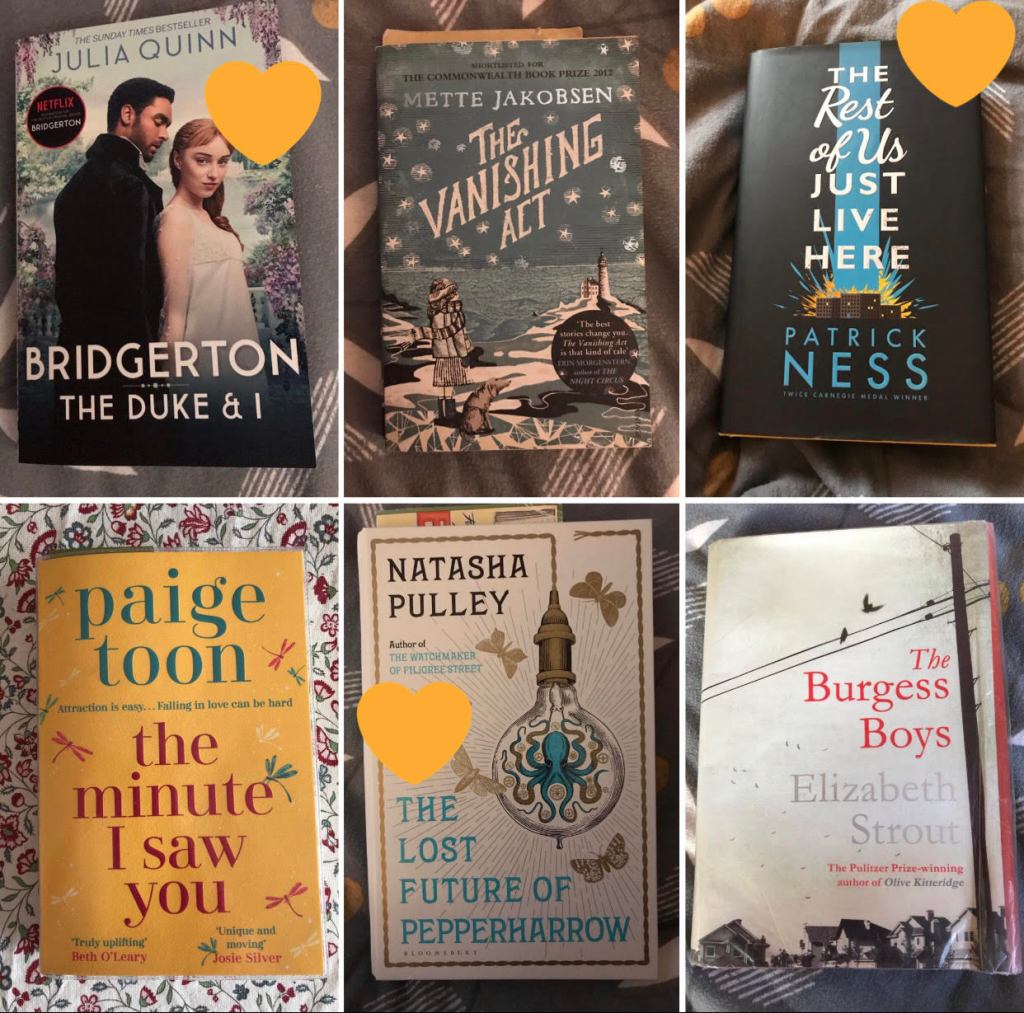
I may not have read many books in February, but they were all grand! A quick shout out to The Vanishing Act, even though I’ve not claimed it as a favourite. It’s so beautifully whimsical and well-told. If you want to develop a constant craving for pretzels and orange cake, give it a read.
The Duke and I by Julia Quinn is a load of jolly nonsense. So exactly what we all need right now! I raced through it, giggling at the ridiculous dialogue and cringy sex scenes. I wouldn’t call it a guilty pleasure, but it’s a series I’ll be returning to whenever I need to shut off reality and have a good laugh. If you liked the TV series, this is more of the same.
The Rest Of Us Just Live Here by Patrick Ness may well be one of my favourite books of all time. It was a reread, and one that I’ll come back to again and again. One quote, to give you a taste of Ness’s beautiful writing:
‘Anxiety is a feeling grown too large. A feeling grown aggressive and dangerous. You’re responsible for its consequences, you’re responsible for treating it. But Michael, you’re not responsible for causing it.’
LUSH. This is a young adult novel with a big heart and characters you will fall in love with and think about long after you’ve turned the last page.
The Lost Future of Pepperharrow by Natasha Pulley is the second in a series, so go back and read The Watchmaker of Filigree Street before you attempt this. It’s the best of magical realism combined with breath-taking romance and thrills. If you love The Night Circus or The Snow Child, you’ll love this.
‘Never trust people who don’t have something in their lives that they love beyond reason.’ – Fredrik Backman
Write for the love of it.
Write because you have a story to tell. Because you have stories to tell. Write because you need to figure out the stories inside of you. Write to be known, to find the others with stories like yours.
Write because 6am doesn’t feel like 6am when you’re getting up to write. Write even when 6am feels very much like 6am because you know that it will make the rest of the day better. Write through yawning and aching and sighing.
Write in bed. Write on trains. Write at desks. Write on your laptop, in pretty notepads, in the notes app on your phone. Write for hours, write in stolen minutes, write for a second.
Write poems. Write epic novels. Write for children. Write for the child you were. Write for your parents. Write things you never want your parents to read. Write for your friends. Write about your enemies. Write for yourself. Write for strangers. Write for the happy. Write for the lonely. Write for people who aren’t born yet. Write for someone on their deathbed.
Write because starting a first draft feels like diving off a cliff, and you don’t know if you’ll land. Write because you like to plan. Write from the start, the middle, or the end. Write a bit of them all.
Write down the ideas that come at midnight, in the shower, on a long drive. Write down the odd things people say. Write down the clever things other writers say. Write even on days when every word feels hard. Write when you’re inspired.
Write alone. Write with a friend. Write with a group.
Write and rewrite. Make your words shine. Write for days to find a sentence that makes sense. Write because when you do find that sentence that makes sense, it feels like finding gold. Write until it feels good enough to share.
Write in silence. Write in chaos. Write in your car. Write despite the washing piling up. Write even when you feel like you should be doing something else. Write instead of seeing friends.
Write because you want to. Write because you need to. Write because there is no way not to.
Write the dreams in your heart. Write the sorrows of your past. Write your fears and vanquish them. Write your hidden disappointments. Write your greatest joys. Write your lost loves.
Write about places you’ve been to. Write about places you will never go to. Write to get under another person’s skin. Write because you want to live better in your own skin.
Write through the rejection. Write through the pain. Write despite the worry. Write when agents don’t get you. Write when publishers don’t get you. Write despite bad reviews. Write despite missing out on awards. Write when the world is falling apart.
Write because seeing your book in a library will never stop being a thrill. Write because hearing that others loved your novel brings you joy. Write because telling stories gives you peace.
Write a story that takes you a lifetime. Write a story that takes you a month. Write bad stories. Write good stories. Write one story. Write ten.
Write because it’s what you’ve always wanted to do. Write because you fell into it. Write because once you started, you couldn’t stop. Write because it’s part of you now. Write from your heart.








 Anna Britton